Select one of the topics we have covered during the semester and offer some suggestions for future trends in this field. Which area of Social Media is set to dominate the eLandscape in the future? There is no right or wrong answer to this question just a well reasoned response will be satisfactory.
Documentary Films have never been a big part of mainstream cinemas the likes of Hoyts or Village, but as many people predict that downfall of cinemas in favour media being delivered to the home. Documentary Films may follows this trend, by bypassing the the cinema screen and being sent straight to the home cinema. This would be for a positive for us living in Australia who often have to wait much longer for Documentarys made in foreign countries, although this used to be true for most movies, the gap between America and Australia in terms of release dates for movies is narrowing, with Australia getting blockbuster films at the same time or even before America.
TBC
Monday, May 31, 2010

Sunday, May 30, 2010
Online Documentary

The problem hindering documentary film makers is the difficulty in getting their work "out there". "out there" being the public sphere. The Internet is a great platform for documentary film makers to get the greatest number of viewers. Documentary's have never been a extremely profitable part of the movie industry, they are often low budget and make little profit, it at all. There are some exceptions to this with documentary film makers such as Michael Moore making films on relatively large budgets for documentary films and making considerable profits. The point of documentary films is not to make profit, it is to inform. But a lot of documentary's wont get the chance to inform, due to limited distribution.
Documentary film makers don't command the huge budgets that Hollywood blockbuster directors use. This is due to the fact Documentary film makers are filming events that are happening naturally, not creating scenes full of expensive pyrotechnics with A-list actors and actresses. This does not mean that Documentary film makers don't need money to tell their stories. Putting production costs aside, the cost it takes to market a film to allow the largest possible audience, is a lot of money. Along comes the internet which allows documentary film makers to distribute their films for a pittance.
I have noticed the trend for more established documentary film makers, has been not been making their movies for the Internet, but for other mediums such as cinema or television and using the Internet as a secondary form of distribution. The Internet is a great platform for documentary's that have already been released in other mediums, to be archived, so as to be viewed by people who may not of been able to view the documentary otherwise. A example of this is the ABC program Four Corners. Four Corners which has been on Australian television since the 60's, presents 45 minute documentaries on a rage on issues on Monday nights at 8:30pm. The short documentary's are from a range of local and international reporters on local and international issues. The website offers an archive of past programs as-well as supplementary material free of charge. This allows for a larger audience for the stories as people can download and watch the documentary's on demand.
Another example is the film Slacker Uprising by Michael Moore. The film is primarily based around the issue of the youth vote in the 2008 American Presidential Election. Along with a DVD release Michael Moore offered and is still offering the the entire movie on his website for free for download, for Americans. This is a clever move by Moore, as young people are more likely to download movies then pay for them, so offering it for free, he can maximize his viewers, viewers who are the the people he is targeting the movie. There is a statement on the website from Moore explaining this "This is being done entirely as a gift to my fans. The only return any of us are hoping for is the largest turnout of young voters ever at the polls in November.".
This is such a large topic that I will be talking about it again in my Final Blog.
The Politics of social media

The anonymity that people posting on Internet sites like You-tube have, allows them to post things that they would never say to the persons face or even post under their true name. This fact poses problems for Political figures contributing videos to websites such as You tube.
Political figures in the western world have always been the subject of satire of parody from cartoons distributed in newspapers and more recently videos posted on the Internet. The ability to ridicule a public figure without the fear of punishment is a civil liberty we often take for granted in the western world, although some may argue that defamation laws may impede our free speech to an extent, we have much more freedom then many nations even today. Mass media in the form of newspapers and television have allowed for higher levels of questioning of public figures actions as-well as ridicule. The Internet however has allowed for more people to have their say on public figures including politicians, and have their views reach a huge audience with just an Internet connection. The main gain is therefore for the average person, as the power of freedom of speech has been given to them in a way that had never been before possible.
People that generate the most ridicule should not be in a position of power, yet throughout history they have been. Some of the most incompetent, idiotic and corrupt leaders are also the ones who do not take kindly to ridicule of themselves. Leaders who have a cult of personality surrounding them such as Hitler and more recently Kim Jong-Il would have their work undone by people be able to subject them to ridicule and parody. However the western leaders that are held in greater esteem (voluntarily) do not completely open the gates for themselves to be ridiculed. The President of the U.S.A., Barack Obama, is notably “techno savy”. He has a You-tube page which he is committed to updating with videos discussing policy and other matters. I was surprised to find out that his also allows for comments on his You-tube videos which I have noticed other leaders do not. Kevin Rudd's pre-pri-ministerial videos did not allow users to post comments (At the time of writing this blog I could not find the videos in question, information is from memory). This means that people could no directly question what he was saying, by starting up a discussion with other You-tube members. This have may an effort to limit spam and offensive material however.
I think political leaders who use social media like You-tube should be commended, but they should be able to take the inevitable criticism that people will post on their videos. Wether it is successful or not depends on the popularity and credibility of the leader. I am fairly certain that for Kim Jong-Il he does not have the credibility. And I am proud to say this under my true name, John Smith.
http://www.youtube.com/user/barackobamadotcom?blend=1&ob=4
(Barack Obama's You-Tube channel)
I want my Iphone.

Will the mobile phone screen become the dominant screen of the 21st century? Do we really need another screen to view movies, take photos, design art and access the Internet? How do the readings influence your answer to the question posed?
Currently, the ability to take photos, view movies and access the Internet on mobile phones is seen by some to be novelty features and by others the most likely replacement of most of their gadgets into one device. As the majority of mobile phones available today can access the internet, take photos and watch movies digital cameras and laptops should be obsolete, but they are not, because the fact that mobile phones although have the capability to do the things that these other devices do, most are unable to do it nearly as well.
The advent of digital cameras on mobile phones was an exciting time (one of the first camera phones is pictured above), although digital cameras were not nearly as popular as they are today, the thought of having a camera on your phone increased the ability to be able to capture any moment you wanted without the need to lug your digital camera around. This may sound like a piece of marketing spin by a phone manufacturer but it was in the forefront of peoples minds. The picture quality of the phones might be touted by those forked out huge amounts for them, as amazing, but in reality the pictures taken were mostly of poor quality. The quality has increased considerably over the years with phones today matching digital camera in specifications but with a large difference in the photos they take, with digital cameras usually taking better quality photos. Quality aside still and video cameras on mobiles have allowed for extraordinary events to be captured on film by ordinary people. When something out of the ordinary happens it is often peoples reaction to pull out their phone and start recording, with the resulting footage ending up either on the news, Youtube or both.
The Internet has been more successful on the mobile platform then the digital camera however. How the Internet is accessed on mobile phones is different to how it is accessed on computers. The internet on mobile phones seems to be popular as people want to get information updates, rather then surfing for lengthy periods like done on a personal computer. Wether it be checking emails and stock tips for business people or checking social networking sites and the weather forecast for normal people.
Sure mobile phones have the ability to view movies, some in HD quality, but this does not nessicarly mean that it is a feature being utilised by most users. The most part is people viewing short clips on Youtube, and sharing them with friends, or videos they have taken with themselves. Watching entire television programs and movies on mobile phones is not a viable option as large screen televisions are becoming the norm.
I am trying not to underestimate the mobile platform, but currently the technology does not seem to be present to replace the other gadgets that we rely on. And as for Art being created on a mobile phone, I remain sceptical.
Tuesday, April 27, 2010
Sex in Cyberspace

Its hard to imagine a time when there wasn't pornography want so prevalent on the Internet when we are living in a time where even innocent searches on Google can yield pornographic results. It makes sense that that pornography has been able to flourish on the Internet. This is due to its delivery system that renders the viewer of pornography anonymous yet able to access hundreds of hours of pornographic footage and view millions of pornographic images all in the privacy of their own home. This may be seen as a positive development by a certain demographic but the impacts this abundance of Internet pornography has many negatives.
As many pornographic websites can be easily be accessed by anybody, there's very little that can be done to prevent children from accessing pornographic material. “The Internet is dangerous because it removes the inefficiency in the delivery of pornography, making porn much more ubiquitous than in the days when guys in trench coats would sell nudie postcards”. (Wired)
Measures can be taken to try and block children from accessing pornographic websites of any website with objectional material however the majority are designed so they can be turned off and on by non-techsavy parents, so children that have grown up with computers can usually get around the filters and access the websites their parents do not wish them to.
Internet Pornography is a huge industry such estimate that the money going in to Internet sex is in the billions each year, and more then 20 percent of Internet users have accessed an 'adult site' (Women and the Web). Forgetting the social problems this industry causes such as body and self image problems, there is money being made from illegal sexual activities such as paedophilia. The Internet provides a virtual meeting place for people producing child porn and people seeking it. As the producers and viewers of child porn can be spread across the globe, this posses a problem for prosecutors trying to uphold the law. There may be more of an incentive to create child porn as sadly there is a market for it all over the world, and money to be made.
Pornography did not suddenly appear when the Internet was created, it has been around in different forms for hundreds of years. The Internet has been the most effective distribution tool of the Pornography Industry however, and it can be said has created a pornographic revolution. This is a problem as many of Internet users are under the age of 18, the age mandated by most western countries to be allowed to view pornography. Most legitimate pornographic websites have disclaimers advising people under the age of 18 not to enter the website, but this depends on the honesty of the person accessing the website.
The pornography industry has boomed on the Internet and probably will remain strong until/if a new delivery system is invented. Porn is a big part of the Internet and this quote from Scrubs sums this fact up nicely “I'm fairly sure that if they took all the porn off the Internet, there would be only be 1 website left, and it would be called Bring Back The Porn”
References:
Link 1: 'Internet Porn: Worse than Crack?' by Ryan Singel
Link 2: 'Women and the Web: Cybersex Activity and Implications' by Marnie C. Ferree.
Tuesday, April 20, 2010
“Shared experiences create a sense of reality”

Video games like Second Life can create an alternate reality in which people can escape their normal lives and be someone else in a virtual world, but I believe the vast majority of people are able to distinguish the game world from the real world. As technology improves however, it may be hard for people to make this distinction.
Online gaming addiction has seen people engross themselves in online communities while alienating themselves from the real world. The attraction comes from the experiences online games like Second Life can offer players. People that may be unhappy with their life can log onto online worlds and create an avatar that can embody every characteristic the player wishes they had. This has ensured that these game worlds are usually filled with avatars who conform to the beauty ideals generated by popular media in society. Its no wonder people would rather be logged on to a game such as Second Life and feel what it is like to be somebody they are not.
>As many online games offer crude graphics compared to console games and PC games, their ability to addict people may be inhibited, but as the graphics improve, games such as Second Life may draw in bigger audiences with more people becoming addicted and neglecting the real world. This is due to the increased realism that improved graphics can deliver. New technologies including 3d can increase realism and therefore immersion. To accept an online game as an extension of reality rather then just a game, allowances have to be made by players so they can immerse themselves in these online games. Allowances such as ignoring the many aspects in which the games cannot simulate reality or even a believable alternate reality.
>As the technology behind video games is rapidly advancing, In the future people may find it harder to leave the virtual worlds created by their video games to function in the real world. It is possible that video games will be able to stimulate all of the senses in such a way that gives people the ability to have an experience that seems completely real. So why would people want to leave the virtual world where they could do extraordinary things, for the real world which is full of problems.
>The statement 'the suspension of disbelief has become a grounding of belief' is true in the sense that many people wish that they could become either similar or identical to their Avatar, however I do not see it becoming a problem to technology reaches a level where games can simulate real life effectively enough for people to question whether the game world is the real world.
Tuesday, March 23, 2010
eExtremists
Upon opening the link for the first time to the Australia First Party's website (http://ausfirst.alphalink.com.au/) I am greeted with the eureka stockade flag, a flag which some see as fast becoming a sign of racism (http://au.news.yahoo.com/thewest/a/-/mp/6707774/eureka-flag-hijacked-by-racists) and a couple of pictures of old white guys. If the name “The Australia First Party” didn't raise my suspicions that I was going to be clicking on a link that directs me to a website spouting racist garbage, the combination of old white guys and the eureka flag on the homepage sure did.
The Australia First Party's website is the host to numerous articles including the subtlety titled yet to be released article “Overseas Students go home!' and the article entitled “Australia Day 2010: Hold High The National Flag! Hold High The Eureka Flag!' which calls the media 'vile' for its condemnation of the youths involved in the Cronulla Riots and with the revolutionary vigor of Maximilien Robespierre, states 'The national resistance is growing. We will reclaim our country'. With statements like that, it makes me wonder why the leader Graeme Campbell of the Australia First party, doesn't just embrace his inner Neo-Nazi self already and shave his head, get a couple of swastika tattoos and change the name of his party to something more fitting, like the Nazi Party.
Groups like this have been allowed to flourish since the advent of the Internet.This is due to the fact groups like this don't get much exposure on television, and any exposure they did get would be negative similar if they were to publish their views in one of the popular newspapers, due to anti discriminatory laws. On the Internet however, they can say as much as they want, without fear of censorship, with relative ease. This is a dangerous situation as it allows similarly minded bigots to congregate. This can lead to organized violence against certain groups in society that bigots usually target;black, Jewish or homosexual people.
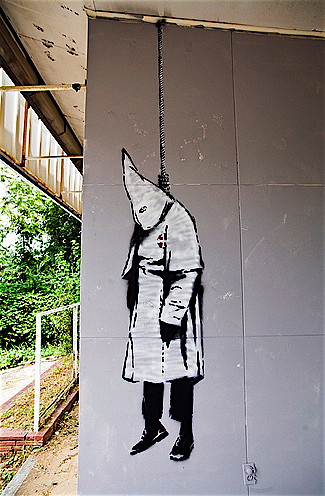
The anonymity that the internet allows people to have means that people can discuss their extreme views on the internet in a meeting place that isn't tangible. Compared to the times where only people wearing white hoods would discuss such views, the Internet allows the bigots a hood that can mask their identity more effectively then one made of fabric. People that do not fit the bill for right wing extremists, may be accessing websites like Aryan nation or more more moderate ones, and contributing to the hate being spouted.
So where does the Australia First party place on the extremity level? Their website could almost be one of a legitimate Australian political party, although major political party's have slightly more modern website design, the content including the mission statement with xenophobic notions such as wanting to “Abolish Multiculturalism “ I am pretty sure the Australia First Party is an extremist group hidden behind a suit and a bad haircut.
Subscribe to:
Posts (Atom)